
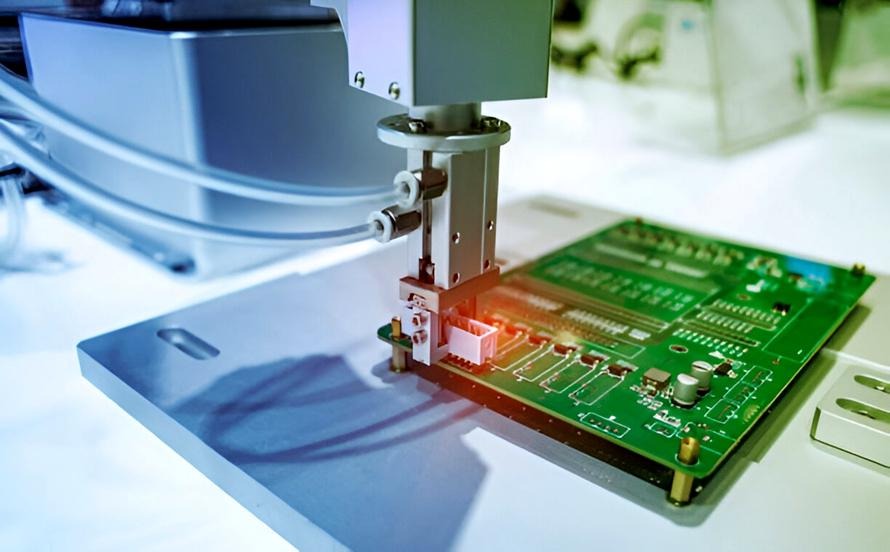
The growing demand for electronic products has increased the need for efficient and reliable large-scale circuit board manufacturing. From consumer electronics and automotive systems to telecommunications equipment and industrial controls, many products require thousands of assembled printed circuit boards. Producing these quantities efficiently requires more than simply increasing the number of boards on a production line. It requires coordinated component sourcing, automated assembly, process control, inspection, and testing.
High-volume PCB assembly is designed to support large production requirements while maintaining consistent quality across manufacturing batches. With the right combination of automation, planning, and quality assurance, manufacturers can improve production efficiency, control unit costs, and maintain reliable assembly performance.
What Is High-Volume PCB Assembly?
High-volume PCB assembly refers to the production of large quantities of assembled printed circuit boards using organized and highly automated manufacturing processes. The exact volume considered “high” depends on the manufacturer, product type, assembly complexity, and production requirements.
Large-scale PCB manufacturing commonly relies on surface mount technology (SMT), where automated equipment places electronic components onto the PCB. Through-hole technology (THT) can also be incorporated when certain components require stronger mechanical connections or specific package types.
The primary goal is to manufacture a large number of consistent assemblies while minimizing production delays, defects, and unnecessary handling.
How Does Large-Scale PCB Assembly Work?
The process begins with engineering preparation. Manufacturers review Gerber files, bill of materials (BOM), pick-and-place data, schematics, assembly drawings, and other production documentation.
Component sourcing is then coordinated according to the production requirements. For high-volume manufacturing, ensuring a stable supply of components is particularly important because shortages can interrupt an entire production schedule.
During SMT production, solder paste is applied to the PCB using a stencil printer. Automated pick-and-place machines position components according to programmed placement data.
The populated boards pass through a reflow oven where controlled heating melts the solder paste and creates reliable solder joints. THT components can be inserted and soldered separately when required.
After assembly, inspection and electrical testing are performed before the boards move to packaging and shipment.
Why Is Automation Important for High-Volume Production?
Automation is essential for efficient large-scale electronics manufacturing. Manually placing thousands of components would require considerable labor and could introduce greater variations between individual assemblies.
Automated placement machines can install components quickly and accurately. Automated solder paste printing and reflow processes also provide greater consistency across production batches.
Automated optical inspection (AOI) can examine large numbers of boards for common defects, including missing components, incorrect placement, polarity errors, and visible soldering problems.
Automation also allows manufacturers to monitor production data and process parameters. This information can help identify changes in equipment performance or process conditions before they result in widespread defects.
What Factors Affect High-Volume PCB Assembly Costs?
Several factors influence the cost of large-scale PCB production. Component prices are a major consideration, particularly when a board contains a high number of parts.
PCB size and complexity also affect manufacturing expenses. Boards with multiple layers, specialized materials, fine-pitch components, or advanced packages may require additional manufacturing controls.
Production volume can help reduce the average cost per unit because setup and programming expenses are distributed across a larger number of boards.
Testing requirements can also affect the final cost. Simple assemblies may require basic inspection, while complex products may need automated testing, X-ray inspection, functional testing, or other specialized procedures.
Panelization can further improve manufacturing efficiency by allowing multiple PCBs to be processed together during assembly.
How Does Component Sourcing Affect Large Production Runs?
Component sourcing becomes increasingly important as production quantities grow. A shortage of a single critical component can delay the assembly of an entire product.
Manufacturers therefore need to monitor component availability, lead times, pricing, and lifecycle status. Advance procurement planning can help ensure that sufficient quantities are available when production begins.
Approved alternative components may also be considered when original parts become difficult to source. Any alternative should be evaluated to ensure that it meets the electrical, mechanical, and environmental requirements of the design.
Reliable component sourcing is also important for product quality. Counterfeit, damaged, or incorrect components can lead to failures and expensive rework.
What Quality Control Is Used in High-Volume PCB Manufacturing?
Maintaining consistent quality across large production quantities requires systematic inspection at multiple stages.
Solder paste inspection can verify that the correct amount of solder paste has been deposited on the PCB pads. AOI can then detect component placement errors and many visible soldering defects.
X-ray inspection is useful for examining hidden solder connections beneath certain component packages. This can help identify problems that cannot be detected through conventional visual inspection.
Electrical testing provides additional verification of the assembled circuit. Depending on the product, manufacturers may use in-circuit testing, functional testing, or other application-specific methods.
Process monitoring is equally important. Tracking reflow temperatures, solder paste performance, placement accuracy, and inspection results can help maintain consistent production conditions.
What Challenges Can Occur During High-Volume Assembly?
Large-scale PCB production can magnify small manufacturing problems. A minor process issue affecting a single board could affect hundreds or thousands of units if it is not detected quickly.
Supply chain interruptions are another major challenge. Component shortages or unexpected lead-time increases can affect production schedules.
Equipment maintenance and calibration are also important. Automated production equipment must operate consistently throughout long manufacturing runs.
Design changes can create additional complexity. If the PCB or BOM changes after production has started, manufacturing programs, component inventories, documentation, and testing procedures may need to be updated.
Effective production planning and communication can help minimize these risks.
How Can PCB Design Be Optimized for High-Volume Manufacturing?
Design for manufacturability (DFM) should be considered before beginning large-scale production. A PCB should be designed so that components can be placed, soldered, inspected, and tested efficiently.
Standard component packages can simplify automated assembly and sourcing. Consistent component orientation can also improve machine efficiency.
Adequate spacing between components helps reduce soldering problems and provides better access for inspection. Designers should also consider board thickness, pad dimensions, solder mask design, fiducials, and panelization.
Prototype production is useful before moving into high-volume manufacturing. Testing an initial batch can reveal design or manufacturing issues while changes are still relatively easy to implement.
How Does Panelization Improve Production Efficiency?
Panelization involves arranging multiple individual PCB designs on a larger manufacturing panel. Instead of processing every board separately, assembly equipment can process multiple units during a single production cycle.
Effective panelization can reduce material waste, handling time, and machine loading operations. It can also improve production throughput.
However, panel design should account for the PCB’s dimensions, assembly equipment, depanelization method, component placement, and mechanical requirements. The goal is to improve efficiency without creating problems during assembly or separation.
Where Is High-Volume PCB Assembly Used?
Large-scale PCB manufacturing is common in industries that produce electronic products in significant quantities. Consumer electronics, home appliances, automotive systems, networking equipment, telecommunications hardware, industrial controllers, security devices, and power electronics can all require high production volumes.
Different applications have different manufacturing requirements. A consumer product may prioritize compact size and production efficiency, while an industrial or automotive assembly may place greater emphasis on environmental reliability and testing.
The manufacturing process should therefore be adapted to the specific product and its performance requirements.
Conclusion
High-volume PCB assembly combines automation, component sourcing, efficient PCB design, process monitoring, inspection, and testing to support large-scale electronics production. Careful planning helps manufacturers maintain consistent quality while improving throughput and controlling production costs. Businesses preparing for large production runs should evaluate manufacturing capacity, sourcing capabilities, inspection systems, testing methods, and scalability before selecting a production partner. An experienced manufacturer providing high volume PCB assembly services can help coordinate these requirements and support reliable production from initial preparation through final delivery.
