
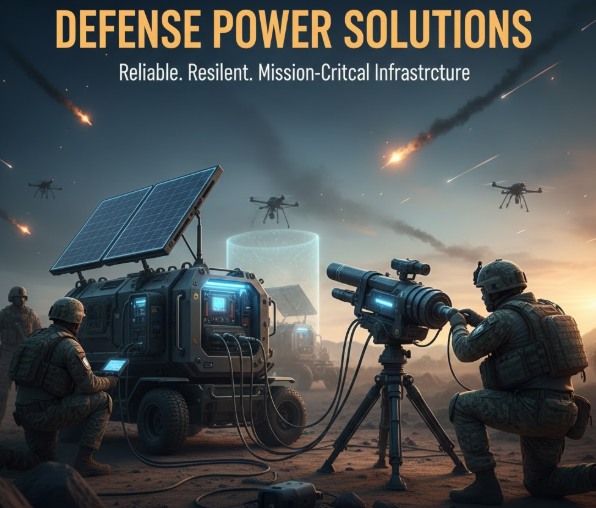
In today’s rapidly evolving defense landscape, energy has become as critical as ammunition or intelligence. The intricate web of modern military operations depends on reliable and resilient defense power solutions — from battlefield communications and autonomous systems to forward operating bases and directed energy weapons. As conventional fuel logistics face increasing vulnerabilities, ruggedized energy systems are no longer optional — they’re mission‑critical infrastructure that enables forces to operate, survive, and dominate in contested environments.
Why Energy Matters in Modern Military Operations
The scale of energy consumption by military forces is massive. The United States Department of Defense alone has historically consumed more fuel than many countries; for example, at one point it used about 12.6 million gallons of fuel per day and roughly 30,000 GWh of electricity annually, ranking its energy use comparable to mid‑sized nations.
Modern defense platforms — including drones, surveillance systems, and advanced communication networks — increasingly rely on battery‑powered electronics and energy‑dense storage solutions. According to recent industry analysis, the global military power solutions market (which includes ruggedized energy systems) was valued at over USD 12 billion in 2025 and is forecast to reach more than USD 25 billion by 2033, growing at a compound annual growth rate (CAGR) of ~9.6%.
What Makes Power Systems Ruggedized
Ruggedized energy systems are engineered specifically to withstand the extreme conditions of combat and expeditionary environments. Unlike commercial power technologies, these systems must endure wide temperature ranges, shock, vibration, dust, moisture, and electromagnetic interference without failure. They integrate hardened components and rigorous testing standards to ensure continuous operation under duress — an imperative for frontline defense power solutions.
Core Components of Ruggedized Defense Power Solutions
Modern ruggedized systems include:
High‑reliability power supplies that deliver stable electricity in chaotic conditions;
Advanced energy storage systems, such as military‑grade batteries designed for vibration and temperature extremes;
Mobile energy systems — from portable tactical generators to microgrid solutions that support expeditionary forces;
Energy management for distributed networks, enabling power allocation across forward units and sensitive electronics.
Such robust architectures are essential for powering everything from night‑vision gear and encrypted radios to autonomous vehicles and battlefield sensors.
Operational Benefits for Defense Forces
The shift to ruggedized energy systems yields significant operational advantages:
Enhanced mission endurance — Soldiers and systems can sustain longer deployments with reduced dependency on traditional fuel convoys, improving force agility.
Reduced logistical vulnerabilities — Fuel supply lines are among the most targeted assets in conflict; durable energy storage and distributed generation minimize these risks.
Powering advanced systems — Emerging technologies like artificial intelligence tools for battlefield analytics require resilient energy frameworks to operate in isolated or energy‑limited theaters.
Rapid deployment capabilities — Portable ruggedized systems support rapid force projection and re‑deployment without extensive infrastructure.
Case Studies & Real‑World Examples
While specific military deployments are often classified, several observable trends illustrate ruggedized energy in action:
- Forces increasingly deploy battery‑powered drones and unmanned systems that rely on resilient energy storage.
- Energy research programs focus on “energy‑aware” AI, designing machine learning tools that optimize power use in low‑energy battlefield contexts.
These developments highlight how energy demands are reshaping tactical planning and defense infrastructure.
Challenges and Future Trends in Military Energy
Despite its strategic importance, integrating ruggedized systems presents challenges:
- Military operations still heavily depend on traditional fuels, which pose significant logistical burdens — for example, historical conflicts have shown up to 7 gallons of fuel may be consumed for every gallon delivered forward after transport shackles.
- Transitioning to hybrid, renewable, and microgrid‑based power solutions offers resilience and reduces reliance on vulnerable supply chains, but it requires systematic doctrinal and technological shifts.
Looking forward, advancements in next‑generation batteries, distributed energy architectures, and sustainable power harvesting will continue elevating the role that ruggedized defense power solutions play in modern militaries worldwide.
Conclusion
As the demands of warfare evolve, so too must the energy solutions that underpin them. Ruggedized energy systems have emerged as indispensable components of defense power solutions, enabling military effectiveness, strategic flexibility, and operational resilience in the most demanding environments. For defense planners and technologists alike, prioritizing rugged, reliable energy infrastructure is essential to maintaining battlefield advantage in the decades ahead.
